The applications of turnstile doors for residential communities
Turnstile doors also called electronic turnstiles play an important role of residential couminity managment all the time.
The iterative evolution of equipment in any industry is never about the blind accumulation of technology; it is the inevitable outcome driven by the demands of social governance, residential safety standards, and urban development policies. As a core security facility at community entrances, turnstile doors have undergone three decades of evolution in China, perfectly illustrating the industry rule that ‘demand determines products, and upgrades adapt to the times.’
Many property management companies and homeowners’ committees hold a misconception: as long as the existing turnstile door access control systems can still allow passage, there is no need to spend money on replacements. However, the truth is that each generation of electrical turnstile doors precisely matched the community management standards of its time. It is not that older equipment is of poor quality; rather, today’s community population structures, safety requirements, governance demands, and compliance standards have long surpassed the capabilities of old equipment.
Before 2010, mechanical turnstiles and card-swiping turnstile doors dominated, suited for open-access communities.
Between 2010 and 2018, automatic turnstiles doors’ performance and functionality became digitalized, meeting basic access control needs.
From 2019 to the present, AI edge smart turnstile doors have emerged to fit smart communities and safe city initiatives. The upgrade across these three generations essentially reflects three major leaps in community security management needs.
This article, drawing on real industry data, side-by-side scenario pain-point comparisons, functional iteration logic, and mandatory national policies, objectively dissects the core drivers behind electronic turnstiles’ iteration and thoroughly explains the urgent necessity for old community turnstile replacements.

1. Core Logic: The Underlying Driver of Turnstile Doors Iteration Is the Continuous Upgrade of Community Management Needs
Over the past three decades, domestic residential communities have transitioned from ‘basic shelter’ to ‘quality living, smart security, and refined governance.’ The three phases have seen vastly different living models, population flow characteristics, and safety requirements, directly driving three technological iterations of pedestrian turnstile gates. Each upgrade precisely corresponded to the pressing social governance needs of its time:
Before 2010: Apart from coastal open cities, communities were mostly managed with open access, relying on simple guard posts and limited resident populations. Security intensity was low, and the core need was merely ‘physical separation and orderly passage.’ Pure mechanical turnstiles and card-swiping turnstile gates fully met the demands of that era.
2010–2018: With national policies spurring a real estate boom, gated communities gradually became standard across inland areas. As urban construction and the economy grew, the influx of outsiders and security risks increased. Industry needs upgraded to ‘access control and orderly passage.’ Second-generation digital access control turnstile doors, equipped with QR code scanning and contactless card reading, became widespread accordingly.
2019 to present: With highly mobile urban populations, large renter groups, and a complex mix of service providers, residents’ demands for personal and property safety, privacy, and convenient access have risen sharply. At the same time, national policies for smart retrofitting of old communities and the creation of safe neighborhoods have introduced mandatory standards. Traditional digital electronic turnstile barrier gates have become completely outdated in terms of control capability, security precision, and intelligence. Concurrently, the nationwide rollout of urban rail transit and comprehensive demands have made AI edge smart turnstiles—featuring facial verification, fingerprint recognition, iris scanning, and even radar detection—a new necessity for the modern era.

2. Panoramic Comparison of Three Generations of Turnstile Doors Iteration: Tailored to Different Era Needs – No Superiority or Inferiority, Only Fit Differences
To objectively present the value of iteration, we compare the three generations across five dimensions—applicable scenarios, core functions, operational data, management capabilities, and maintenance costs—using publicly available measured data and real-world case studies to clearly illustrate their differences and underscore the inevitability of today’s upgrades.
1. 0 Pure Mechanical and Card-Swiping Turnstile Doors (Standard Before 2010): Suitable for Basic Passage in Early Open-Access Communities
At this stage, communities had no strict security control requirements. Residents were mostly unit employees or locals, with stable populations and very few transient outsiders, and crime rates were extremely low. The design logic of pure mechanical and card-swiping elctronic turnstile gates perfectly matched the minimalist management needs of the time.
Core Adaptability: Relying on pure mechanical structures and optional card verification units, these turnstiles achieved pedestrian turnover without needing power, had no circuit failures, and required no routine maintenance—satisfying the basic need for “orderly passage” in open communities.
Limitations of the Era (Why They Are Unsuitable Today): No passage records, no anti-intrusion mechanisms. According to 2024 statistics from the community security industry, the average daily floating population in modern urban communities accounts for 28.7%. With frequent movement of strangers, renters, delivery personnel, and repair workers, pure mechanical turnstiles offer zero control capability and are completely unable to meet modern community security needs. They have now been fully phased out from mainstream residential scenarios.
2. 0 Traditional Digital Turnstile Doors (Mainstream in Communities from 2010–2018): Suitable for Basic Gated Access Management in the Mid-Period
During this phase, gated management became universal in domestic communities. To solve the basic problem of ‘strangers entering at will,’ digital turnstile gates with credential verification emerged. At the time, they perfectly filled the access control gap and represented the optimal technological solution.
Core Adaptability: Inductive IC/ID card verification, QR code verification, power-activated start/stop, and infrared anti-pinch functions—achieving ‘verified entry, strangers barred’ and establishing a rudimentary community entrance control system. They suited the low mobility and low management standards of communities a decade ago.
Key Shortfalls Today (Supported by Data):
As cities developed, community management scenarios changed dramatically, and the original functions have fallen completely behind. Multiple measured data points reveal clear deficiencies:
Insufficient Security Precision: Only card and QR code verification, no liveness detection. Card duplication, lending, and fraudulent use rates reach as high as 41.3%. QR codes, which emerged after 2015, were also limited in adoption and relied on traditional infrared sensors, resulting in a 38.6% miss rate for tailgating and pass-back—unable to handle today’s high-mix pedestrian flows.
Lagging Throughput Efficiency: Peak single-lane throughput peaks at only 18 persons/minute, leaving a capacity gap of over 40% compared to modern community morning and evening rush hours, frequently causing entrance congestion.
Relatively High Maintenance Costs: Constrained by early manufacturing processes and component technologies, equipment over 5 years old averages 12–15 failures per year. Annual maintenance and manual guarding costs are 65% higher than those of new equipment.
No Data Management Capability: No photo capture, no traceability, no visitor flow statistics—failing to meet modern community public security traceability and detailed ledger management requirements, and not meeting current comprehensive governance assessment standards.
In summary, traditional security turnstile doors are not inherently poor; they were designed for the lower standards of a decade ago. Facing today’s high-mobility, high-security, and high-intelligence community governance requirements, their capabilities are thoroughly exhausted.
3.0 New-Generation Digital + AI Edge Turnstile Doors (Mainstream from 2019 to Present): Tailored for the Essential Governance Needs of Modern Smart Communities
Targeting the industry pain points of large floating populations, multiple security risks, high governance standards, and high operating costs, the new generation of smart electronic pedestrian turnstiles has undergone comprehensive iteration. Every functional optimization and technological upgrade precisely matches the real management needs of today’s communities, representing the best solution driven by the demands of the era.
Access Security Upgrade – Solving the Pain of Mixed Populations and Fraudulent Entry:
Upgraded to multimodal verification including facial recognition, QR codes, millimeter-wave radar, and temporary visitor passes, eliminating card duplication and misuse. Equipped with AI human-trajectory algorithms, the tailgating miss rate is reduced to below 0.8%, a 48-fold improvement in security precision over traditional pedestrian turnstile doors. Full photo capture and data traceability perfectly resolve the industry challenges of managing strangers and tracing security incidents.
Throughput Efficiency Upgrade – Adapting to Peak-Hour Flows in Modern Communities:
AI millisecond-level recognition response boosts peak single-lane throughput to 32 persons/minute, a 77.8% increase over traditional gate turnstiles, essentially eliminating morning/evening rush-hour entrance congestion and resident complaints. Smart differentiation between pedestrians, wheelchairs, and luggage carts accommodates all user groups.
Hardware and Process Upgrade – Significantly Reducing Property Maintenance Pressure:
Comprehensive upgrades in components and processes: industrial-grade main and auxiliary boards and brushless servo motors replace conventional generic parts, extending equipment service life from 5 million to 10 million start-stop cycles—doubling durability. Annual failure frequency drops by over 85%, greatly reducing repair material and labor costs, delivering long-term cost-effectiveness far superior to old equipment.

Intelligent Management Upgrade – Supporting Refined Governance in Smart Communities:
Seamless integration with property management platforms and comprehensive governance systems enables automatic visitor flow statistics, report generation, and proactive alerts for abnormal behavior, achieving unmanned, data-driven, and intelligent entrance management. This fills the core gaps of traditional equipment—low manual control efficiency and lack of governance data—perfectly aligning with the refined governance needs of modern communities.
III. Mandatory Policy Requirements: Replacing Old Turnstile Doors Is an Essential Compliance and Urban Upgrade Necessity
The upgrade of community smart electronic turnstile doors is driven not only by commercial progress but also by explicit mandatory requirements from national housing policies, public security standards, and urban evaluation criteria. It is a compliance renovation project that communities must implement.
1. National Old-Community Renovation Policies Clearly Define the Scope
The State Council’s ‘Guiding Opinions on Comprehensively Promoting the Renovation of Old Urban Residential Communities’ (Document No. 23 [2020] of the General Office of the State Council) explicitly includes ‘upgrading community intelligent security facilities and intelligent entrance control’ in the basic renovation list for old communities, requiring the reinforcement of technological security and the elimination of outdated and ineffective security equipment.
In 2024, the Ministry of Housing and Urban-Rural Development and the National Development and Reform Commission jointly issued the ‘Special Plan for Intelligent Upgrading of Urban Infrastructure,’ further emphasizing the promotion of full coverage of facial recognition, smart turnstile doors, and traceable capture systems at residential community entrances to enhance grassroots security intelligence.
2. Mandatory Indicators for Safe Communities and Civilized City Assessments
The evaluation standards for National Civilized Cities, Safe Communities, and Smart Communities explicitly require that gated communities possess four capabilities: intelligent credential verification, anti-tailgating intrusion prevention, passage data traceability, and abnormal behavior alerts. Motorized turnstile doors installed before 2018 do not meet these criteria, directly affecting community awards, property star ratings, and comprehensive governance assessment scores.
3. Compliance Requirements for Comprehensive Social Security Governance
According to the ‘Regulations on Comprehensive Social Security Governance’ and the ‘General Requirements for Security Prevention in Residential Communities,’ entrances must have effective personnel control, security traceability, and anti-illegal-intrusion functions. Old digital and pure mechanical turnstile gates no longer meet current security compliance standards and are considered lagging facilities. Upgrading is a baseline compliance requirement.

1. Value Closed Loop of Replacement: Adapting to Era Needs and Achieving a Win-Win for Government, Property, and Residents
Based on community management needs, technological iteration trends, and national policy requirements, upgrading old turnstiles to new smart devices is an essential measure for adapting to the times, delivering holistic value enhancement.
For Government and Communities: Solidifying Grassroots Governance and Supporting Urban Upgrading
Smart turnstile doors can effectively reduce the incidence of theft, illegal intrusion, and other security incidents in communities. According to comprehensive governance data, communities that have completed smart turnstile upgrades see a 72% reduction in security disputes and risks, significantly easing grassroots governance pressure, helping achieve Civilized City and Safe Community certifications, and enhancing the city’s refined governance image.
For Property Management: Cost Reduction, Efficiency Enhancement, and Improved Service Reputation
The new generation of pedestrian electronic turnstile gate features low failure rates, minimal maintenance, and intelligent automated control, reducing manual guarding and repair costs by more than 60%. Data traceability and smart alert functions resolve the traditional problems of management loopholes and high complaint rates, making entrance management more standardized and efficient, effectively boosting property service ratings and resident satisfaction.
For Residents: Enhanced Sense of Safety and Improved Community Quality
Precise intelligent security turnstile systems fundamentally prevent tailgating and illegal intrusion risks, comprehensively protecting residents’ personal and property safety. The efficient and convenient passage experience, along with clean and standardized equipment appearances, simultaneously elevate the living quality and sense of well-being, effectively increasing the overall valuation of the community.
Conclusion: Embracing Iteration in Line with the Times Is the Core of Long-Term Community Governance
Looking back at three decades of turnstile doors evolution, there are no outdated devices—only outdated fit. Pure mechanical and traditional automatic turnstile gates perfectly suited the community management needs of their respective eras. However, with urban development, increased population mobility, and elevated security standards, the governance demands of modern communities have already undergone leapfrog iteration.
Today, replacing old community turnstile doors with new-generation digital and AI edge smart turnstiles is not over-upgrading; it is a necessary measure to align with technological progress, meet governance imperatives, comply with national policies, and ensure resident safety. It is about using technological iteration to adapt to the demands of the times, fill the security gaps in communities, and achieve a comprehensive upgrade in safety, quality, and value.


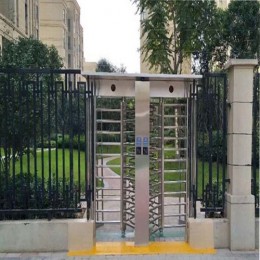
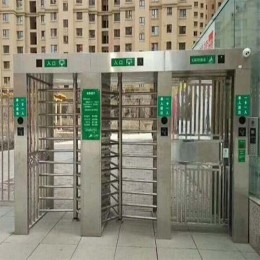

 Double Lane Full Height Turnstile Gate for Residential Area
 Dual Lane Tandem Full Height Turnstile Gate for Industry Park
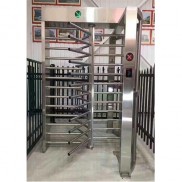 Single Full Height Security Turnstile for Office Buildings
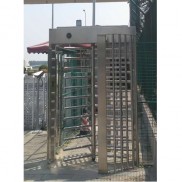 Motorised Double Full-Height Turnstile for Office Buildings
Please leave a message if you are interested in this model